
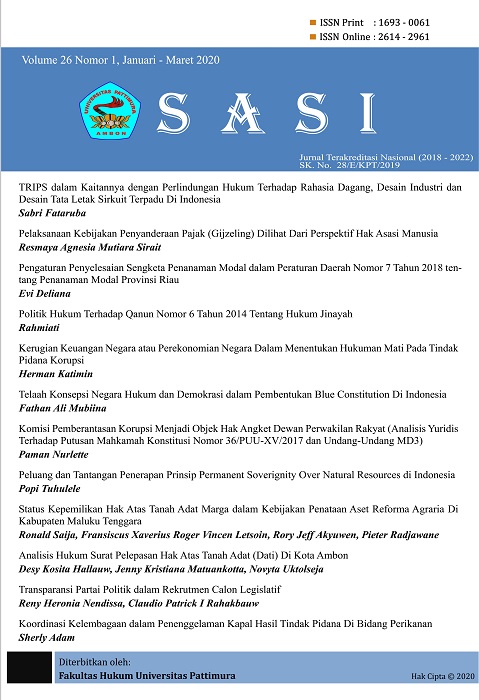
Pelaksanaan Kebijakan Penyanderaan Pajak (Gijzeling) Dilihat Dari Perspektif Hak Asasi Manusia
DOI:
https://doi.org/10.47268/sasi.v26i1.192Keywords:
Forced Bodies, Tax Insurers, Human RightsAbstract
Tax is a source of income for a country, the use of tax money to finance all state expenditures and financing state development projects. Tax collection is carried out by the state to taxpayers or tax bearers. The current monetary crisis makes many taxpayers who do not obey in paying taxes. So the government must create a new mechanism that aims to help forcibly for taxpayers who do not obey the law. One such mechanism is the forced institution of body (gijzeling). In establishing gijzeling institutions, there are things that must be considered and considered, namely the legal, justice and humanitarian needs (Human Rights), because basically these institutions contain elements of deprivation of liberty. This study aims to analyze how the institution of forced agency (gijzeling) is implemented and how the implementation of tax hostage policy (gijzeling) is seen from the perspective of Human Rights. From the results of the study, it is known that the enforced implementation of the body can be carried out if other administrative legal activities are proven and the tax guarantor has arrears a tax payment of Rp 100,000,000-, and viewed from the perspective of human rights taking a tax (gijzeling) is basically a deprivation of a person's right to independence, but related to the tax guarantor who has no good intention, gijzeling can be applied.References
Buku
[1] Ashofa, Burhan. (2001). Metode Penelitian Hukum, Jakarta: Rineka Cipta.
[2] Bohari. (2006) Pengantar Hukum Pajak, Jakarta: Raja Grafndo Persada.
[3] Brotodihardjo, R Santoso. (2008), Pengantar Ilmu Hukum Pajak, Bandung: Refika Aditma.
[4] Hidayah, Khoirul dan Mudawamah. (2015). Gizjeling dalam Hukum Pajak di Indonesia Kajian Perundang-Undangan dan Integrasi Islam, Malang: UIN Maliki Press.
[5] Ilyas, Wirawan B. (2010). Hukum Pajak Edisi 5, Jakarta: Salemba.
[6] Muladi, (2002). Demokratisasi Hak Asasi Manusia dan Reformasi Hukum di Indonesia, Jakarta: The Habibie Center.
[7] Pudyatmoko, Y Sri. (2007) Penegakan dan Perlindungan Hukum di Bidang Pajak, Jakarta: Salemba.
[8] Rusjdi, Muhammad. (2007). PPSP: Penagihan Pajak Dengan Surat Paksa, Jakarta: Indeks.
[9] Soekanto, Soerjono. (1985). Penelitian Hukum Normatif, Jakarta: Rajawali.
[10] Soekanto, Soerjono dan Mamudji, Sri. (2004). Penelitian Hukum Normatif Suatu Tinjauan Singkat, Jakarta: Raja Grafindo Persada.
[11] Santoso, Sani Imam. (2014). Teori Pemidanaan dan Sandera Badan, Jakarta: Penaku.
Jurnal dan Lain-Lain
[12] Ismail, Tjip. (2001). Penyanderaan sebagai upaya Law Enforcement, Majalah Hukum Bisnis
[13] Naibaho, Artha Polma. P, Nyoman Serikat. Ispriyanrso, Budi. (2016). Paksa Badan (Gijzeling) Sebagai Instrumen Penangihan Pajak (Kajian Yuridis Dari Perspektif Hukum Pidana), Jurnal Hukum Vol. 5 No.3, Semarang: Universitas Diponegoro.
[14] Sundary, Ririn Irianti. (2003). Kebijakan Menerapkan Lembaga Paksa Badan (Gijzeling) Dalam Rangka Penegakan Hukum Pajak Dalam Perspektif Hak Asasi Manusia Dan Hukum Islam, Volume XIX No. 4 Oktober – Desember
Downloads
Published

Article History
Issue
Section
License
Copyright (c) 2020 Resmaya Agnesia Mutiara Sirait

This work is licensed under a Creative Commons Attribution-NonCommercial 4.0 International License.
How to Cite
Article Metrics