
Archives
-
Volume 32 Issue 3, September 2026
Vol. 32 No. 3This issue (SASI Volume 32 Issue 3 Year 2026) was made available online for the regular issue on July 27, 2026. All articles in this issue (8 original research articles) include 27 authors from 4 countries/regions of origin (Indonesia, Malaysia, India, dan Timor-Leste).
-
Volume 32 Issue 2, June 2026
Vol. 32 No. 2This issue (SASI Volume 32 Issue 2 Year 2026) was made available online for the regular issue on June 30, 2026. All articles in this issue (8 original research articles) include 27 authors from 7 countries/regions of origin (Indonesia, Malaysia, Uzbekistan, Timor-Leste, India, Hungary, Spain).
-

Volume 32 Issue 1, March 2026
Vol. 32 No. 1This issue (SASI Volume 32 Issue 1 Year 2026) was made available online for the regular issue on March 24, 2026. All articles in this issue (8 original research articles) include 25 authors from 6 countries/regions of origin (Indonesia, Georgia, Malaysia, Viet Nam, Algeria, Russian Federation). -

Volume 31 Issue 4, December 2025
Vol. 31 No. 4This issue (SASI Volume 31 Issue 4 Year 2025) was made available online for the regular issue on November 17, 2025. All articles in this issue (9 original research articles) include 30 authors from 6 countries/regions of origin (Indonesia, Uzbekistan, United States, Philippines, United Kingdom, Iran). -

Volume 31 Issue 3, September 2025
Vol. 31 No. 3This issue (SASI Volume 31 Issue 3 Year 2025) was made available online for the regular issue on September 30, 2025. All articles in this issue (8 original research articles) include 29 authors from 4 countries/regions of origin (Indonesia, Thailand, France, Timor-Leste). -

Volume 31 Issue 2, June 2025
Vol. 31 No. 2This issue (SASI Volume 31 Issue 2 Year 2025) was made available online for the regular issue on June 29, 2025. All articles in this issue (8 original research articles) include 25 authors from 5 countries/regions of origin (Indonesia, India, Australia, Japan, Thailand). -

Volume 31 Issue 1, March 2025
Vol. 31 No. 1This issue (SASI Volume 31 Issue 1 Year 2025) was made available online for the regular issue on March 29, 2025. All articles in this issue (7 original research articles) include 24 authors from 3 countries/regions of origin (Indonesia, Malaysia, Finland). -

Volume 30 Issue 4, December 2024
Vol. 30 No. 4This issue (SASI Volume 30 Issue 4 Year 2024) has been made available online for the regular issue on December 31, 2024. All articles in this issue (8 original research articles) include 23 authors from 3 countries/regions of origin (Indonesia, Nigeria, Malaysia). -

Volume 30 Issue 3, September 2024
Vol. 30 No. 3This issue (SASI Volume 30 Issue 3 Year 2024) has been made available online for the regular edition on September 30, 2024. All articles in this issue (7 original research articles) include 17 authors from 4 countries/regions of origin (Indonesia, Chile, Malaysia, Iran). -

Volume 30 Issue 2, June 2024
Vol. 30 No. 2This issue (SASI Volume 30 Issue 2 Year 2024) was made available online for the regular issue on June 28, 2024. All articles in this issue (7 original research articles) include 22 authors from 5 countries/regions of origin (Indonesia, Algeria, Netherlands, Spain, Malaysia). -

Volume 30 Issue 1, March 2024
Vol. 30 No. 1This issue (SASI Volume 30 Issue 1 Year 2024) has been made available online for the regular edition on March 31, 2024. All articles in this issue (9 original research articles) include 27 authors from 6 countries/regions of origin (Indonesia, Germany, New Zealand, Nepal, Malaysia, Hungary). -

Volume 29 Issue 4, December 2023
Vol. 29 No. 4This issue (SASI Volume 29 Issue 4 Year 2023) has been made available online for the regular edition on October 30, 2023. All articles in this issue (18 original research articles) include 50 authors from 3 countries/regions of origin (Indonesia, Malaysia, Turkey). -

Volume 29 Issue 3, September 2023
Vol. 29 No. 3This issue (SASI Volume 29 Issue 3 Year 2023) has been made available online for the regular edition on June 12, 2023. All articles in this issue (18 original research articles) include 45 authors from 2 countries/regions of origin (Indonesia, Malaysia). -

Volume 29 Issue 2, June 2023
Vol. 29 No. 2This issue (SASI Volume 29 Issue 2 Year 2023) has been made available online for the regular edition on April 19, 2023. All articles in this issue (18 original research articles) include 39 authors from 2 countries/regions of origin (Indonesia, Thailand). -

Volume 29 Issue 1, March 2023
Vol. 29 No. 1This edition (SASI Volume 29 Issue 1 Year 2023) has been made available online for the regular edition on March 11, 2023. All articles in this issue (18 original research articles) include 48 authors from 2 countries/regions of origin (Indonesia and Timor Leste). -

Volume 28 Issue 4, December 2022
Vol. 28 No. 4This issue (SASI Volume 28 Issue 4 Year 2022) was made available online for the regular edition on December 30, 2022. All articles in this issue (16 original research articles) include 32 authors from 1 country/region of origin (Indonesia). -
Volume 28 Issue 3, September 2022
Vol. 28 No. 3This edition (SASI Volume 28 Issue 3 Year 2022) has been made available online for the regular edition on October 13, 2022. All articles in this issue (14 original research articles) include 29 authors from 2 countries/regions of origin (Indonesia, United States). -

Volume 28 Issue 2, June 2022
Vol. 28 No. 2This edition (SASI Volume 28 Issue 2 Year 2022) has been made available online for the regular edition on May 7, 2022. All articles in this issue (12 original research articles) include 32 authors from 1 country/region of origin (Indonesia). -
Volume 28 Issue 1, March 2022
Vol. 28 No. 1Introduction
After the Covid-19 pandemic that had an impact on the nation's economy, which resulted in a slump in the law in Indonesia in law enforcement efforts related to economic recovery. Foreign investors who invest in Indonesia, if law enforcement in Indonesia cannot achieve legal certainty and justice for investors, it is certain that investors will invest in other countries. The downturn in the law and the downturn in the economy are interrelated, resulting in public distrust in law enforcement, this has an impact on crime and other criminal acts.
SASI Volume 28 Number 1 March 2022 is the inaugural edition of the accredited SINTA 2, which publishes several legal issues that are in the spotlight, are: Strengthening and Utilizing Original Tanimbar Woven Fabric as a Form of Preservation of Traditional Cultural Expression; Legal Status of the Who’s Covid-19 Investigator in International Law Perspective; Implementation of Working Agreement with Probationary Period in Financial Industry According to Labor Law; Analysis of Neglected Justice in Land Disputes in Ambon District Court; Utilization and Management of Marine Resources in the Coastal Area Based On Regional Autonomy; Rule of Law and Rule of Ethic in Law Enforcement in Indonesia; The Law Protection for the Woman Victim of Violence on Traditional Marriage; Implications of Correspondence Inference Attribution Theory & Behavioral Jurisprudence Theory: Judges’ Conciderations on Conscience; Legal Implications of Foreign Investment Relating to Technology Transfer in the Patent Regime; State Recognition and Respect for the Rights of Customary Law Communities in the Maluku Islands Region in the Exploitation of Forest Resources; Justice for the Rights of the Women's Heirs to the Land of Dati; Optimization of the Use of Technology for Taxpayers in the Tax System in Indonesia; Involvement of Indigenous People In The Utilization of Natural Resources For Investment Activities; A Steep Gall in International Environmental Law Enforcement (An Analysis of International Deforestation); Responsibilities of Regency/Municipal Governments in Managing Basic Education Affairs.
The scientific thoughts studied above are an effort to develop and renew the science of law in the future, hopefully these writings are useful.
-
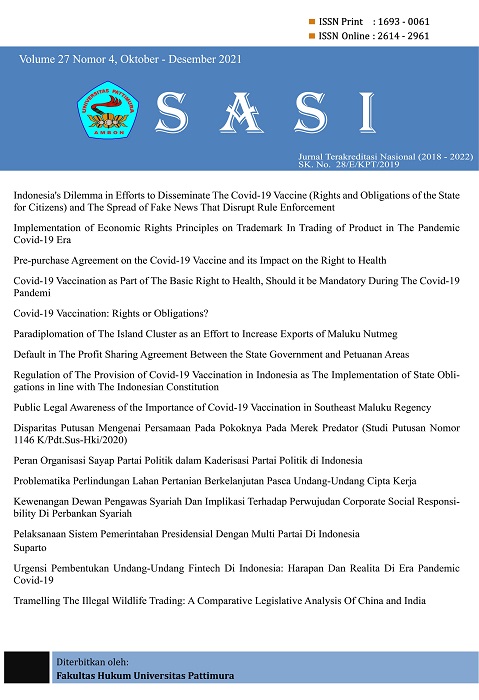
Volume 27 Nomor 4, Oktober - Desember 2021
Vol. 27 No. 4 (2021)Introduction
Large-Scale Social Restrictions and physical distancing as the government's legal politics in the Covid-19 handling policy, but have not been maximized in protecting the health of the Indonesian people.
In this edition of volume 27 Number 4 October - December 2021 some of the legal issues that are in the spotlight are: Indonesia's Dilemma in Efforts to Disseminate The Covid-19 Vaccine (Rights and Obligations of the State for Citizens) and The Spread of Fake News That Disrupt Rule Enforcement; Implementation of Economic Rights Principles on Trademark In Trading of Product in The Pandemic Covid-19 Era; Pre-purchase Agreement on the Covid-19 Vaccine and its Impact on the Right to Health; Covid-19 Vaccination as Part of The Basic Right to Health, Should it be Mandatory During The Covid-19 Pandemi; Covid-19 Vaccination: Rights or Obligations?; Paradiplomation of The Island Cluster as an Effort to Increase Exports of Maluku Nutmeg; Default in The Profit Sharing Agreement Between the State Government and Petuanan Areas; Regulation of The Provision of Covid-19 Vaccination in Indonesia as The Implementation of State Obligations in line with The Indonesian Constitution; Public Legal Awareness of the Importance of Covid-19 Vaccination in Southeast Maluku Regency; Disparity of Decisions Regarding Equality in Basically Predator Brands (Study of Decision Number 1146 K/Pdt.Sus-Hki/2020); The Role of Political Party Wing Organizations in the Cadreization of Political Parties in Indonesia; Problems of Protecting Sustainable Agricultural Lands After the Job Creation Act; The Authority of the Sharia Supervisory Board and the Implications for the Realization of Corporate Social Responsibility in Sharia Banking; Implementation of a Presidential Government System with Multi-Parties in Indonesia; The Urgency of the Establishment of a Fintech Law in Indonesia: Expectations and Realities in the Era of the Covid-19 Pandemic; Tramelling The Illegal Wildlife Trading: A Comparative Legislative Analysis Of China and India.
The scientific thoughts studied above are an effort to develop and renew the science of law in the future, hopefully these writings are useful. -
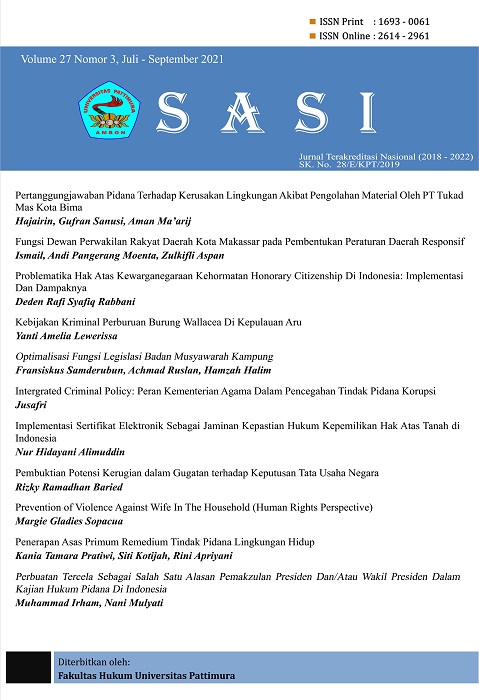
Volume 27 Nomor 3, Juli - September 2021
Vol. 27 No. 3 (2021)Introduction
Law is a rule that is always located wherever we stand, but the application of law in one country is different from the law in other countries. The existence of law in a country there is customary law that applies to each region, namely the law that is born from the culture and local wisdom of ethnic groups. Aristotle, a famous philosopher from Greece, he defined the law into two namely Specific Laws and Universal Laws. Specific Laws are rules that stipulate or prohibit different types of actions. While the Universal Law is a natural law that has its own internal order and direction.
In this edition of volume 27 Number 3 July-September 2021, several legal issues that are in the spotlight are: Criminal Liability for Environmental Damage Due to Material Processing by PT Tukad Mas Kota Bima; The function of the Makassar City Regional House of Representatives in the Formation of Responsive Regional Regulations; The Problem of the Right to Honorary Citizenship in Indonesia: Its Implementation and Impact; Wallacea Bird Hunting Criminal Policy In Aru Islands ; Optimizing the Legislation Function of the Village Consultative Body; Integrated Criminal Policy: The Role of the Ministry of Religion in the Prevention of Corruption; Implementation of Electronic Certificates as Legal Certainty Guarantees of Land Rights Ownership in Indonesia; Proof of Potential Losses in Lawsuits Against State Administrative Decisions; Prevention of Violence Against Wife In The Household (Human Rights Perspective); Application of the Primum Remedium Principle for Environmental Crimes; Disgraceful acts as one of the reasons for impeaching the president and/or vice president in the study of criminal law in Indonesia.
The scientific thoughts studied above are an effort to develop and renew the science of law in the future, hopefully these writings are useful.
-
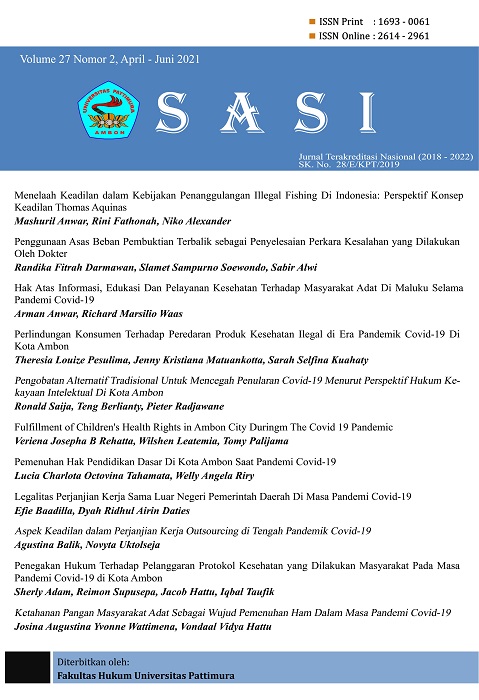
Volume 27 Nomor 2, April - Juni 2021
Vol. 27 No. 2 (2021)Introduction
Handling and law enforcement in the field of the COVID-19 pandemic is still a priority, so it is obligatory to provide education to the public because the source of Covid-19 transmission is the community, so that the regional government discloses the type and distribution of the potentially infectious disease.
In this edition of volume 27 Number 2 April-June 2021, some of the legal issues that are in the spotlight are: Examining Justice in Policies to Combat Illegal Fishing in Indonesia: Perspectives on the Concept of Justice Thomas Aquinas; The use of the principle of the burden of inverse proof as the settlement of Errors committed by doctors; The Right to Information, Education and Health Services for Indigenous Peoples in Maluku During the Covid-19 Pandemic; Consumer Protection Against Illegal Health Product Circulation in the Era of the Covid-19 Pandemic in Ambon City; Traditional Alternative Medicine to Prevent Covid-19 Transmission According to the Perspective of Intellectual Property Law in Ambon City; Fulfillment of Children's Health Rights in Ambon City Duringm The Covid 19 Pandemic; Fulfillment of Basic Education Rights in Ambon City During the Covid-19 Pandemic; Fulfillment of Basic Education Rights in Ambon City During the Covid-19 Pandemic; Legality of Regional Government Foreign Cooperation Agreements During the Covid-19 Pandemic; Aspects of Fairness in Outsourcing Work Agreements in the Midst of the Covid-19 Pandemic; Aspects of Fairness in Outsourcing Work Agreements in the Midst of the Covid-19 Pandemic; Law Enforcement Against Public Health Protocol Violations During the Covid-19 Pandemic in Ambon City; Food Security of Indigenous Peoples as a Form of Fulfillment of Human Rights During the Covid-19 Pandemic.
The scientific thoughts studied above are an effort to develop and renew the science of law in the future, hopefully these writings are useful.
-
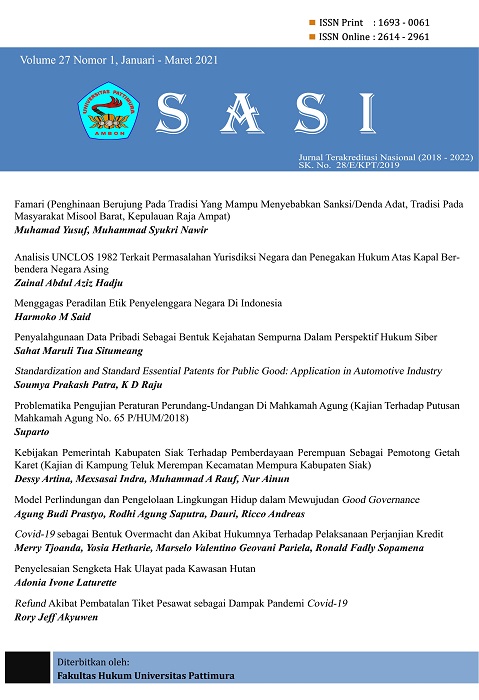
Volume 27 Nomor 1, Januari - Maret 2021
Vol. 27 No. 1 (2021)Introduction
Legal issues in 2021 during the Covid-19 pandemic are still a concern because Indonesia as a state of the law has a constitutional responsibility in providing protection and law enforcement during the Covid-19 pandemic, as in accordance with the expectations of the community, namely professionals in protection and law enforcement without neglecting welfare community in the face of the Covid-19 pandemic.
In this edition of Volume 27 Number 1, January - March 2021, several legal issues that are in the spotlight are: Famari (Insult leads to a tradition that can lead to customary sanctions / fines, traditions in the West Misool community, Raja Ampat Islands); 1982 UNCLOS Analysis Regarding Problems of State Jurisdiction and Law Enforcement of Foreign Flagged Vessels; Initiating Ethical Court of State Administrators in Indonesia; Misuse of Personal Data as a Perfect Crime in Cyber Law Perspective; Standardization and Standard Essential Patents for Public Good: Application in Automotive Industry; The Problems of Testing Legislation in the Supreme Court (Study of the Supreme Court Decision No. 65 P / HUM / 2018); Siak Regency Government Policy Towards Empowerment of Women as Rubber Gum Cutter (Study in Teluk Merempan Village, Mempura District, Siak Regency); Environmental Protection and Management Model in Realizing Good Governance; Covid-19 as a Form of Overmacht and its Legal Effects on Credit Agreement Implementation; Settlement of Land Rights Disputes in Forest Areas; Refund due to the cancellation of airplane tickets as a result of the Covid-19 pandemic.
The scientific thoughts studied above are an effort to develop and renew legal science in the future, I hope these writings are useful.
-
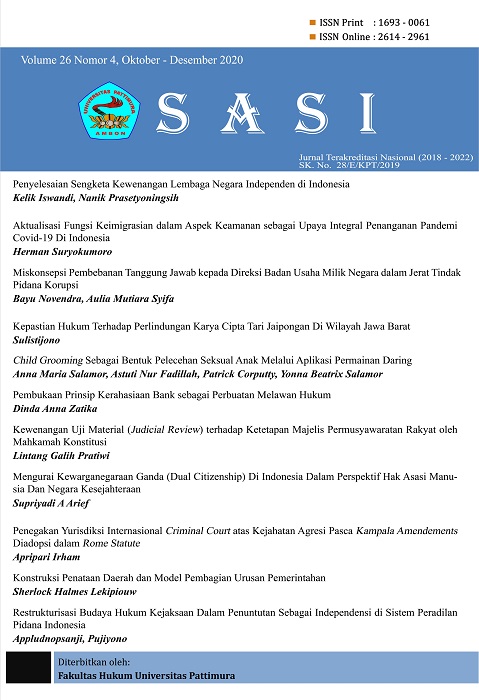
Volume 26 Nomor 4, Oktober - Desember 2020
Vol. 26 No. 4 (2020)Introduction
Every person in carrying out their daily life in this world has their own rules. These rules are usually in the form of prohibitions or orders in doing something, this is known as the law. This regulation is implemented as an effort to protect the public if they experience crimes or threats from other people. People in their daily life need law as mutual peace and tranquility. The existence of law in society to regulate and minimize various people's lives to form a life order that is safe, orderly, and just. Indonesia as a rule of law thus regulates every citizen the exercise of rights and obligations. This is as mandated in the 1945 Constitution of the Republic of Indonesia Article 1 paragraph (3) that law is a necessity in the life of the nation and state because the existence of law can create order and justice in society.In this edition of volume 26 Number 4 October -December 2020, several legal issues that are in the spotlight are: Dispute Resolution of the Authority of Independent State Institutions in Indonesia, Actualization of Immigration Functions in the Security Aspect as an Integral Effort to Handling the Covid-19 Pandemic in Indonesia, Misconceptions of Imposing Responsibilities to the Directors of State-Owned Enterprises in the Crime of Corruption, Legal Certainty Against the Protection of Jaipongan Dance Creations in the West Java Region, Child Grooming as a Form of Child Sexual Abuse through Online Game Applications, Opening of Bank Confidentiality Principles as Unlawful Actions, Authority for Material Testing ( Judicial Review) on the Decree of the People's Consultative Assembly by the Constitutional Court, Parsing Dual Citizenship in Indonesia in the Perspective of Human Rights and Welfare State, Upholding International Jurisdiction of the Criminal Court for Post-Kampala Amendments Aggression Crimes Adopted in the Rome Statute, Regional Arrangement Construction and Government Affairs Sharing Models, Restructuring the Legal Culture of the Attorney General's Office in Prosecution as Independence in the Indonesian Criminal Justice System.
The scientific thoughts studied above are an effort to develop and renew legal science in the future, I hope these papers are useful. -
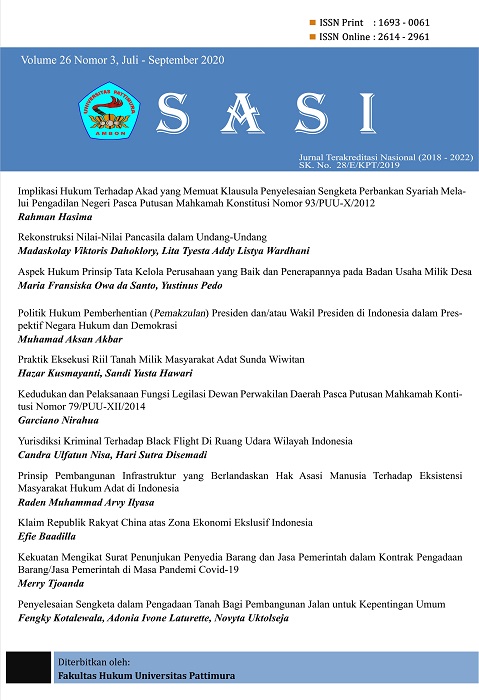
Volume 26 Nomor 3, Juli - September 2020
Vol. 26 No. 3 (2020)Introduction
The Covid-19 pandemic for people who work in the business world, leaves a legal problem, one of which is whether the Covid-19 pandemic has an impact on contract implications in the procurement of goods and services, if this situation can be categorized as force majeure. The term force majeure is not defined in the Civil Code (KUHPerdata) and several regulations in Indonesia. However, according to the world trade organization, namely the International Chamber of Commerce, force majeure is an event or situation that prevents or prevents a party from performing one or more of its contractual obligations based on an agreed contract. A situation can be said to be force majeure if it can be proven that the obstacle is beyond its control; the circumstances cannot reasonably be predicted at the completion of the contract; and the consequences of the obstruction cannot reasonably be avoided or overcome by the affected party. From this explanation, the Covid-19 pandemic is a force majeure, because the pandemic is beyond the control of the parties, cannot be predicted in advance, and results in the blocking of the parties from carrying out their contractual obligations.
In this edition of volume 26 Number 3 July - September 2020, several legal issues that are in the spotlight are: Legal Implications for the Contract which Contains the Clause on Sharia Banking Dispute Resolution Through the District Court after the Constitutional Court Decision Number 93/PU-X/2012; Reconstruction of Pancasila Values in Law; Legal Aspects of the Principles of Good Corporate Governance and Their Application to Village-Owned Enterprises; Legal Politics of Dismissal (impeachment) of the President and/or Vice President in Indonesia in the perspective of a rule of law and democracy; Real Execution Practices of Land Belonging to the Sunda Wiwitan Indigenous Peoples; Position and Implementation of the Legatory Function of the Regional Representative Council after the Decision of the Constitutional Court Number 79/PUU-XII/2014; Criminal Jurisdiction Against Black Flight in Indonesian Territory Airspace; Principles of Infrastructure Development Based on Human Rights on the Existence of Customary Law Communities in Indonesia; The People's Republic of China Claims on Indonesia's Exclusive Economic Zone; Strength Binding Letter of Appointment of Government Goods and Services Providers in Government Goods/Services Procurement Contracts during the Covid-19 Pandemic; Dispute Resolution in Land Acquisition for Road Development for Public Interest.
The scientific thoughts studied above are an effort to develop and renew legal science in the future, I hope these papers are useful.
1-25 of 43
Next