
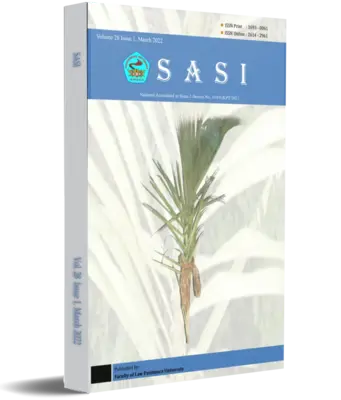
SASI

About the Journal


Journal Title: SASI
ISSN Online: 2614-2961
ISSN Print: 1693-0061 
DOI: 10.47268/sasi by Crossref
Frequency: 4 issues per year (March, June, September, December)
Editor in Chief: Muchtar Anshary Hamid Labetubun
Associate Editor: La Ode Angga
Publisher: Faculty of Law, Universitas Pattimura
Indexing: DOAJ SINTA 2 | another indexing
Citation Analysis: SCOPUS | Dimensions
Deposit Policy: JISC(SHERPA/RoMEO)


Journal Description

SASI is an international, peer-reviewed, open-access journal published by the Faculty of Law, Universitas Pattimura, Indonesia. The journal is dedicated to advancing scholarship on Customary Law, with particular emphasis on Indigenous Legal Systems, Legal Pluralism, Living Law, and Local Wisdom within diverse legal, social, cultural, and environmental contexts.

SASI serves as an international forum for scholarly dialogue on the evolving role of customary law in regulating social relations, resolving disputes, governing indigenous communities, and addressing contemporary legal challenges. The journal publishes high-quality legal research examining the interaction between customary law, state law, religious law, and other normative orders, reflecting the dynamic realities of legally plural societies.

Recognizing Indonesia as one of the world's most legally diverse jurisdictions, with hundreds of indigenous communities and long-established customary legal traditions, SASI connects local legal experiences with regional and global scholarship through comparative perspectives. The journal welcomes doctrinal, empirical, comparative, socio-legal, anthropological, and interdisciplinary research that advances international understanding of Customary Law, Indigenous Legal Systems, Legal Pluralism, Living Law, and Local Wisdom.

Committed to academic excellence and international collaboration, SASI encourages research that contributes to legal theory, judicial practice, legislative development, legal reform, and evidence-based policy relating to indigenous peoples, customary governance, community-based justice, sustainable resource management, and the protection of indigenous peoples' rights. The journal particularly values manuscripts that demonstrate clear theoretical contribution, comparative analysis, empirical evidence, or interdisciplinary perspectives relevant to an international readership.

Explore the journal's Focus & Scope to learn more about its editorial direction and research areas.


International Contributions Welcome

SASI particularly welcomes original and comparative research from scholars worldwide whose work advances the understanding of Customary Law, Indigenous Legal Systems, Legal Pluralism, Living Law, and Local Wisdom. The journal encourages submissions from all regions and jurisdictions that examine indigenous and customary legal systems through comparative, interdisciplinary, empirical, and cross-jurisdictional perspectives, fostering international collaboration and enriching global legal scholarship.


SASI has been nationally accredited by the Ministry of Higher Education, Science, and Technology of the Republic of Indonesia, Number 295/C/C3/KPT/2026 (Grade 2 / SINTA 2), Valid from Vol. 31 No. 1, 2025 until Vol. 35 No. 2, 2029

Before submission,
You have to make sure that your paper is prepared using the SASI paper TEMPLATE, has been carefully proofread and polished, and conforms to the author's guidelines

Online Submissions
1. Already have a Username/Password for SASI? GO TO LOGIN
2. Need a Username/Password? GO TO REGISTRATION

Registration and login are required to submit items online and to check the status of current submissions.

Editorial Speed Metrics

65
Days
Submission to First Decision ?
102
Days
Submission to Acceptance ?
3
Days
Acceptance to Publication ?
74.5
%
Acceptance Rate ?

About Editorial Speed Metrics

Editorial Speed Metrics are calculated automatically from the journal's editorial workflow. Processing times are reported as median values rather than averages because the median provides a more representative measure of the typical editorial timeline by reducing the influence of unusually short or long processing times.

Acceptance Rate is calculated only from manuscripts that have received a final editorial decision (Accepted or Declined). Manuscripts still under review, revision, copyediting, or production are excluded from the calculation.

All metrics are calculated exclusively from peer-reviewed research articles and are updated automatically as editorial records change.

About Editorial Performance Metrics

Announcements

Mandatory ORCID iD Authentication for Corresponding Authors Before Manuscript Submission

2026-06-21

To improve author identification, metadata quality, and international visibility of published research, all Corresponding Authors are required to connect and authenticate their ORCID iD through their OJS profile before submitting a manuscript. Manuscript submissions cannot be completed without a verified ORCID iD.

Read more about Mandatory ORCID iD Authentication for Corresponding Authors Before Manuscript Submission


Current Issue

Volume 32 Issue 3, September 2026
					View Volume 32 Issue 3, September 2026
Published: 2026-07-27

Articles

View All Issues

SASI has been indexed by :

DOAJ OpenAlex sinta GARUDA Dimension 

View full indexing services.