
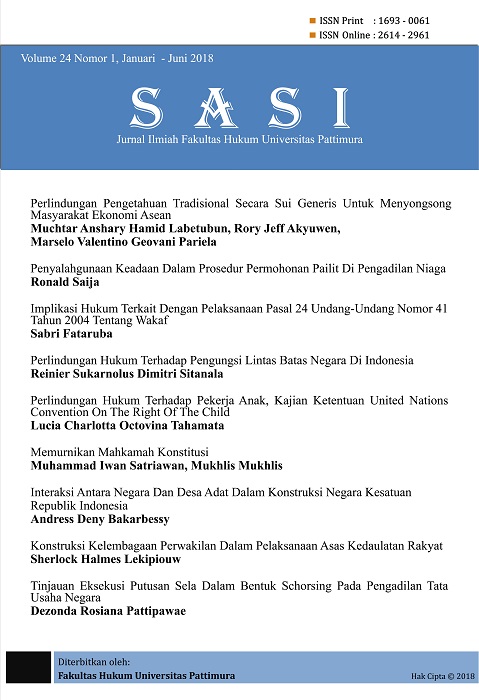
Perlindungan Hukum Terhadap Pengungsi Lintas Batas Negara Di Indonesia
DOI:
https://doi.org/10.47268/sasi.v24i1.116Keywords:
Refugees, Legal ProtectionAbstract
The protection of these cross-border refugees has already been regulated in international law, namely the Geneva Convention 1951 and the 1967 Protocol, but Indonesia is not a party to ratify the Convention. So far Indonesia has only dealt with the problem of cross-border refugees from a priesthood perspective. This resulted in many violated human rights. Indonesia as a transit country must cooperate with the country of origin, destination country and UNHCR to overcome and provide protection for cross-border refugees. The role taken is based on humanity's consideration of the suffering of cross-border refugees and the protection of Human Rights.References
Badudu, Yus. (1994), Kamus Bahasa Indonesia, Sinar Harapan, Jakarta.
Hamid, Sulaiman. (2002), Lembaga Suaka dalam Hukum Internasional, PT Raja Grafindo Persada, Jakarta.
Hendri, John. (1996), Penanggulangan Imigran Gelap di Indonesia, Bina Cipta Perkasa, Jakarta.
Santoso, Iman. (2005), Perspektif Imigrasi dalam Pembangunan Ekonomi dan KetahananNasional, Universitas Indonesia Press, Jakarta.
Boer, Mauna. (2005), Hukum Internasional : Pengertian Peranan dan Fungsi dalam Era Dinamika Global, Alumni Bandung.
Sudrajat Havid, Ajat. (2002) Protecting Refugee-A Field Guide for NGO’s; Pengungsi dalam Kerangka Kebijakan Keimigrasian Kini dan Yang Akan Datang.
Thontowi, Jawahir. (2002), Hukum Internasional di Indonesia, Madya Press.Yokyakarta.
Wagiman. (2012), Hukum Pengungsi Internasional, Sinar Grafika, Jakarta.
Undang-Undang Nomor 6 Tahun 2011 tentang Keimigrasian
Downloads
Published

Article History
Issue
Section
License
Copyright (c) 2018 Reinier Sukarnolus Dimitri Sitanala

This work is licensed under a Creative Commons Attribution-NonCommercial 4.0 International License.
How to Cite
Article Metrics