
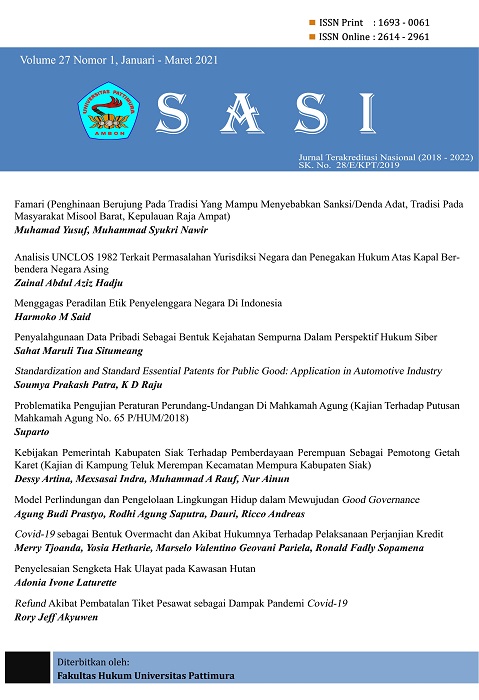
Famari (Penghinaan Berujung Pada Tradisi Yang Mampu Menyebabkan Sanksi/Denda Adat, Tradisi Pada Masyarakat Misool Barat, Kepulauan Raja Ampat)
DOI:
https://doi.org/10.47268/sasi.v27i1.225Keywords:
Famari, Traditions, IndigenousAbstract
One of the traditions that exist in the people of the West Misool islands is the Famari tradition. This tradition is usually carried out when someone from another village humiliates people from another village. This tradition is a tradition from generation to generation, but is only an oral story and has never been written into a written story. This study aims to determine the implementation model of the Famari tradition in communities in West Misool District, Raja Ampat Islands, and the methods used by indigenous peoples to maintain the Famari tradition in West Misool District, Raja Ampat Islands. This research is a qualitative descriptive study using a social phenomenological paradigm. Sources of data for analyzing research problems were obtained from two sources, namely: primary data and secondary data. The results show that the origin of the Famari tradition was created by the ancestors of the West Misool community in creating order, in which there are universal values such as the principle of mutual cooperation, human social function and property in society, consent as a general power, the principle of representation and deliberation. What causes the emergence of the Famari tradition is that in restoring moral balance, it creates collective awareness from community groups to neutralize differences. The Famari tradition does not see the time when it must be carried out, the form of fines in the Famari tradition is determined based on an agreement, the number of people who follow the tradition has no clear limit. Customary fines payment techniques in the Famari tradition are carried out after the party. Without an official invitation, residents came and got involved, to take part in Famari activities. The Famari tradition was created to avoid degrading other social groups, where there are sanctions as punishment for those who are guilty and restore moral balance in society.
References
[1] Apriyani, Rini. (2018). Keberadaan Sanksi Adat Dalam Penerapan Hukum Pidana Adat. Jurnal Hukum Prioritas, 6 (3), 227-246. https://trijurnal.lemlit.trisakti.ac.id/prioris/article/view/3178.
[2] Dewantara, Asep. (2013). Peran Elit Masyarakat: Studi Kebertahanan Adat Istiadat di Kampung Adat Urug Bogor, Buletin Al-Turas, 19 (1), 89-117. https://doi.org/10.15408/bat.v19i1.3703.
https://doi.org/10.15408/bat.v19i1.3703
[3] Humaeni, Ayatullah. (2015). Tabu Perempuan Dalam Budaya Masyarakat Banten. Jurnal Humaniora, 27 (2), 174-185. https://doi.org/10.15408/bat.v19i1.3703.
https://doi.org/10.15408/bat.v19i1.3703
[4] Hartini, Agnesia., Linda, Veronoka. (2017). Pembukuan Kasus Hukum Adat Sebagai Upaya Mengkonsistenkan Sanksi Adat Bagi Masyarakat Di Dusun Empaong Kecamatan Sekadau Hulu Kabupaten Sekadau. Jurnal PEKAN, 2 (1), 33-43. https://doi.org/10.31932/jpk.v2i1.195.
[5] Harahap, Anwar Sadat., Hasibuan, Ahmad Laut., Siregar, Taufik. (2018). Kearifan Lokal Dalam bentuk Sanksi Hukum Bagi Pelanggar Pada Masyarakat Adat Batak Bagian Selatan. Anthropos: Jurnal Antropologi Sosial dan Budaya, 3 (2), 122-130. https://doi.org/10.24114/antro.v3i2.8791
https://doi.org/10.24114/antro.v3i2.8791
[6] Hardiman, Yogi., Kotijah, Siti., Sina, La. (2019). Restorative Justice Terhadap Pelaku Tindak Pidana Ringan Yang Telah Diberi Sanksi Adat. Mulawarman Law Review. l4 (1), 29-43. https://doi.org/10.30872/mulrev.v4i1.48.
https://doi.org/10.30872/mulrev.v4i1.48
[7] Jaya, Nyoman Serikat Putra. (2016). Hukum (Sanksi) PidanaAdat Dalam Pembaharuan Hukum Pidana Nasional. Masalah-Masalah Hukum, 45 (2), 123-130. https://doi.org/10.14710/mmh.45.2.2016.123-130.
https://doi.org/10.14710/mmh.45.2.2016.123-130
[8] Mulyono, Sutrisno Purwohadi. (2014). Kebijakan Sinoptik Penerapan Hukum Adat Dalam Penyelenggaraan Pemerintahan. Jurnal Yustisia, 3 (2), 68-76. https://doi.org/10.20961/yustisia.v3i2.11096.
https://doi.org/10.20961/yustisia.v3i2.11096
[9] Rahman, Abdul., Jamhuri., Irwansyah. (2018), Sanksi Adat Bagi Pelaku Kekerasan Fisik Ditinjau Menurut Hukum Pidana Islam. Jurnal Petita, 3 (2), 137-144. https://doi.org/10.22373/petita.v3i2.49.
https://doi.org/10.22373/petita.v3i2.49
[10] Dillistone, F.W. (2002). Daya Kekuatan Simbol, The Power Of Symbols, Yogyakarta: Kanisius.
[11] Jenks, Chris. (2013). Cultur, Studi Kebudayaan. Yogyakarta: Pustaka Pelajar.
[12] Muhammad, Bushar. (2006). Azas-Azas Hukum Adat, Suatu Pengantar. Jakarta: Pradnya Paramita.
[13] Ritzer, George., Goodman, Douglas J. (2011). Teori Sosiologi Modern. Jakarta: Kencana Prenada Media Group.
[14] Scharf, Betty R. (2004). Sosiologi Agama. Jakarta: Prenada Media.
[15] Turner, Bryan S. (2012). Teori Sosial Dari Klasik Sampai Postmodern. Yogyakarta, Pustaka Pelajar.
Published

Article History
Issue
Section
License
Copyright (c) 2021 Muhamad Yusuf, Muhammad Syukri Nawir

This work is licensed under a Creative Commons Attribution-NonCommercial 4.0 International License.
How to Cite
Article Metrics