
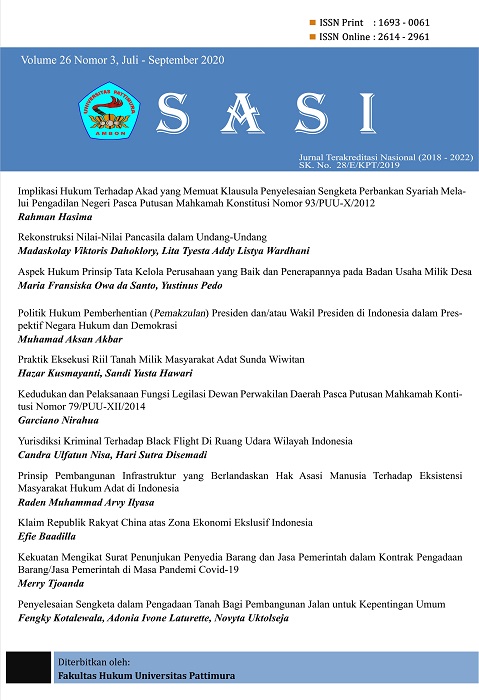
Kedudukan dan Pelaksanaan Fungsi Legislasi Dewan Perwakilan Daerah Pasca Putusan Mahkamah Kontitusi Nomor 79/PUU-XII/2014
DOI:
https://doi.org/10.47268/sasi.v26i3.309Keywords:
The Status, Legislation Function, Local Representative CouncilAbstract
The Local Representative Council is one of barometers of reformation success in Indonesian state administration. as the Local Representative Council becomes a new legislative institution that will strengthen and work closely with previously-established legislative institutions (People's Representative Council). This study aims to: (1) find out and identify the status of legislation function of Local Representative Council based on the regulation after the decision of Constitutional Court; and (2) find out and identify the implementation of legislation function of Local Representative Council based on the regulation after the decision of Constitutional Court. The research method used normative research with a statute approach and a conceptual approach and analyzed descriptive qualitative. The results show that the constitutional authority of Indonesian Local Representative Council as a legislator institution is still very weak. Since the decision of Constitutional Court was read, from normative perspective, there is no any legislation change, either in planning, proposing, or discussing the regulation draft in the Indonesian Parliament, related to the authority of Indonesian Local Representative.
References
[1] Andryan, Lubis, M. S, Suhaidi dan Nasution, F. A. (2013), "Penguatan Fungsi Legislasi Dewan Perwakilan Daerah dalam Sistem Ketatanegaraan Republik Indonesia (Analisis Putusan Mahkamah Konstitusi No. 92/PPU-X/2012)", USU - Law Journal, 3 (2).
[2] Bidaya, J. (2012). "Kewenangan DPD Dalam Sistem Ketatanegaraan RI Menurut UUD 1945", Media Bina Ilmiah, 6 (6).
[3] Dermawan. Moh (2014). "Kedudukan Dewan Perwakilan Daerah dalam Kelembagaan Legerlatif Menurut UUD 1945". Jurnal Ilmu Hukum Legal Opinion, 4 (2).
[4] Hamdi, M. F. (2018). "Rekonstruksi Kedudukan Dewan Perwakilan Daerah Setelah Putusan Mahkamah Konstitusi No. 79/PUU-XII/2014". Kanun, 20 (1).
https://doi.org/10.24815/kanun.v20i1.9767
[5] Hantoro, N. M. (2013). "Kewenangan Dewan Perwakilan Daerah dalam Pembentukan Undang-Undang Pasca Putusan Mahkamah Konstitusi Nomor 92/PUU-X/2012". Jurnal Negara Hukum, 4 (2).
[6] Hidayat, T (2015). "Penerapan sistem soft bikameral dalam Parlemen di Indonesia", JOM, 2 (2).
[7] Jumadi. (2019). Penguatan Fungsi Pengawasan DPD RI Dalam Sistem Bikameral Parlemen, Jurisprudentie, (6) 1.
[8] Marzuki, M. (2018). "Analisis Kontestasi Kelembagaan DPD Dan Upaya Mengefektifkan Keberadaannya", Jurnal Hukum, 1 (15).
https://doi.org/10.20885/iustum.vol15.iss1.art7
[9] Neta, Y. (2011). "Upaya peningkatan peran Dewan Perwakilan Daerah (DPD) di Indonesia", Flat Justisia: Jurnal Ilmu Hukum, 5 (1).
https://doi.org/10.25041/fiatjustisia.v5no1.196
[10] Riyanto, A. (2016). "Penataan Kewenangan Dewan Perwakilan Daerah Republik Indonesia menuju Strong Bicameralism", Jurnal Cahaya Keadilan, 4 (2).
https://doi.org/10.33884/jck.v4i2.929
[11] Rudy, D. J. T dan Hadjon, E. T. L. (2018). "Implikasi dari Putusan Mahkamah Konstitusi Nomor 92/PUU-X/2012 Dalam Kaitannya Dengan Tugas Fungsi dan Kewenangan DPD". Kertha Negara, 06 (03).
[12] Yuriska. (2010). "Kedudukan dan fungsi Dewan Perwakilan Daerah (DPD) dalam Sistem Ketatanegaraan Indonesia", 2 (2).
[13] Zada, K. (2013). "Kewenangan Legislasi Dewan Perwakilan Daerah Dalam Reformasi Kelembagaan Perwakilan Pasca Putusan Mahkamah Konstitusi", Jurnal Cita Hukum, 3 (1).
https://doi.org/10.15408/jch.v2i1.1839
[14] Ali, Z. (2009). Metode Penelitian Hukum, cet pertama, Jakarta: Sinar Grafika.
[15] Asshiddiqie, J. (2006). Perkembangan dan Konsolidasi Iembaga Negara Pasca Reformasi, Jakarta: Konstitusi Press.
[16] Asshiddiqie, J. (2010). Perkembangan dan Konsolidasi Lembaga Negara Pasca Reformasi, Jakarta: Sinar Grafika,
[17] Hadjon, P. M.. (2009). Argumentasi Hukum, Gadjah Mada University Press, Yogyakarta
[18] Manan, B. (2004). Perkembangan Undang-Undang Dasar 1945, FH UII Press: Yogyakarta
[19] Robert, E, R. (2005). Mengenal DPD-RI Sebuah Gambaran Awal, Jakarta: Institute For Local Development.
[20] Hadjon, P. M. (1997). Pengkajian Ilmu Hukum, Pelatihan Metode Penelitian Hukum Normatif, Pusat Penelitian Pengembangan Hukum, Lembaga Penelitian Universitas Airlangga, bekerja sama dengan Fakultas Hukum Universitas Airlangga, Surabaya.
[21] Panduan Pemasyarakatan Undang-Undang Dasar Negara Republik Indonesia Sesuai dengan Urutan Bab, Pasal, dan Ayat, Sekretariat Jenderal MPR RI, 2005.
Downloads
Published

Article History
Issue
Section
License
Copyright (c) 2020 Garciano Nirahua

This work is licensed under a Creative Commons Attribution-NonCommercial 4.0 International License.
How to Cite
Article Metrics