
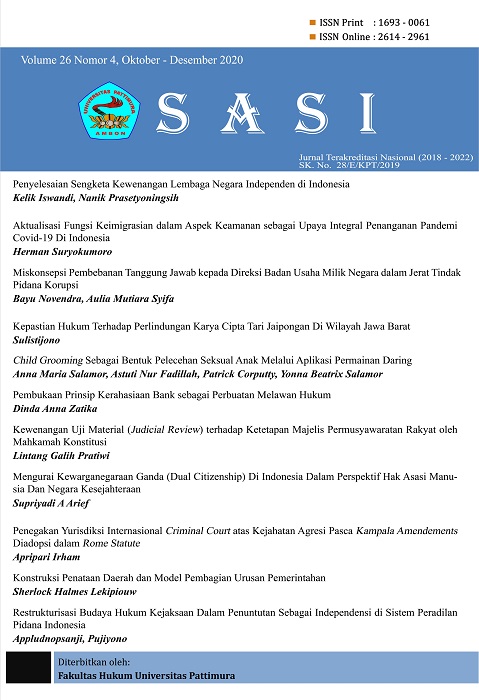
Penegakkan Yurisdiksi International Criminal Court atas Kejahatan Agresi Pasca Kampala Amendments Diadopsi dalam Rome Statute
DOI:
https://doi.org/10.47268/sasi.v26i4.272Keywords:
Jurisdiction of Internasional Criminal Court, Crimes of Aggeession, Kampala Amendments.Abstract
Until the entry into force of the Rome Statute, the definition of the crime of aggression was not also found in it. This leaves the International Criminal Court (ICC) without jurisdiction over crimes of aggression. The absence of ICC jurisdiction over crimes of aggression has resulted in military aggression that has not been processed by the ICC during the time when the proxy war / cold war was initiated. This means that the violation of delicto jus gentium juice is allowed even after the ICC has been established. This study aims: (1) to identify and identify the definition, limitations, and jurisdiction of the ICC for crimes of aggression; and (2) to determine the enforcement of ICC jurisdiction over crimes of aggression after the Kampala Amendments were adopted into the Rome Statute. The research method uses a type of normative research with a statutory approach and a historical approach. The results show that the ICC's definition, limitations, and jurisdiction over the crime of aggression have existed in the Rome Statute since Kampala Amendments were adopted into the Rome Statute. However, until now the enforcement of the ICC's jurisdiction over crimes of aggression has not been carried out concretely.References
Jurnal
[1] Bone, S. (2011). "Urgensi Statuta Roma 1998 Terhadap Kejahatan HAM Dalam Konflik Israel dan Palestina". Jurnal Amanna Gappa, 19 (3): 324-343.
[2] Ferencz, B. B. (2007). "Enabling the International Criminal Court to Punish Aggression". Washington University Global Studies Law Review, 6 (5).
[3] Gunakaya, W. (2013). "Peranan dan Prospek "Internasional Criminal Court" Sebagai International Criminal Policy Dalam Menanggulangi "International Crimes". Jurnal Wawasan Hukum, 29 (2).
[4] Hartono, Bambang dan Hapsari, Recca Ayu. (2019). "Mutual Legal Assistance Pada pemberantasan Cyber Crime Lintas Yurisdiksi di Indonesia". SASI, 25 (1): 59-71. DOI: https://doi.org/10.47268/sasi.v25i1.136 DOI: https://doi.org/10.47268/sasi.v25i1.136
[5] Nurhidayatuloh. (2011). "Kejahatan Agresi Dalam Tatanan Hukum Internasional Modern Sebagai Peremptory Norm". QISTI: Jurnal Ilmiah Ilmu Hukum, 5 (2).
[6] Noor, T. (2014). "Agresi dan Kejahatan Terhadap Perdamaian". Supremasi Hukum, 3 (1). DOI: https://doi.org/10.14421/sh.v3i1.1946
[7] Nisa, Candra Ulfatun dan Disemadi, Hari Sutra. (2020). "Yurisdiksi Kriminal Terhadap Black Flight Di Ruang Udara Wilayah Indonesia", SASI, 26 (3): 365-379. DOI: https://doi.org/10.47268/sasi.v26i3.289 DOI: https://doi.org/10.47268/sasi.v26i3.289
[8] Suryokusumo, S. (2005). "Agresi Dalam Perspektif Hukum Internasional". Jurnal Hukum Internasional, 3 (1). DOI: https://doi.org/10.17304/ijil.vol3.1.2
[9] Tomlinson, B. R. (2003). "What was the Third World". Journal of Contemporary History, 38 (2). https://doi.org/10.1177/0022009403038002135 DOI: https://doi.org/10.1177/0022009403038002135
[10] Wulandari, D. A. (2015). "Agresi Amerika Serikat Terhadap Irak Periode 2003-2010", Journal of Internasional Relations, 1 (2): 132-140.
[11] Yustitianingtyas, L. (2014). "Pertanggungjawaban Negara Dalam Perspektif Hukum Humaniter Dalam Tindakan Agresi (Studi Kasus: Agresi Israel ke Lebanon Tahun 2006)", Perspektif Hukum, 14 (1): 33-52. DOI: http://dx.doi.org/10.30649/phj.v14i1.30.
[12] Zuhra, N. M. (2020). "Kategorisasi Kejahatan Agresi atas Tindakan Penggunaan Kekerasan Negara Perancis Pada Konflik Republik Mali Dalam Hukum Pidana Internasional". Jurnal Selat, 7 (2): 223-238, DOI: https://doi.org/10.31629/selat.v7i2.1872 DOI: https://doi.org/10.31629/selat.v7i2.1872
Buku
[13] Atmasasmita, R. (2006). Pengantar Hukum Pidana Internasional. Bandung: Refika Aditama.
[14] Cassese, A. (2003). Internasional Criminal Law. Oxford: Oxford University Press.
[15] Kittichaisaree, K. (2001). International Criminal Law. Oxford: Oxford University Press
[16] Muladi. (2011). Statuta Roma 1998 Tentang Mahkamah Pidana Internasional Dalam Kerangka Hukum Pidana Internasional dan Implikasinya Terhadap Kerangka Hukum Pidana Nasional. Bandung: Alumni.
[17] Robertson, G. (2002). Kejahatan Terhadap Kemanusiaan: Perjuangan Untuk Mewujudkan Keadilan Global. Jakarta: Komisi Hak Asasi Manusia.
[18] Shaw, M. N. (2008). Hukum Internasional. Cambridge: Cambridge University Press.
[19] Suarda, I. G. W. (2012). Hukum Pidana Internasional Sebuah Pengantar. Bandung: Citra Aditya Bakti.
[20] Widyawati, A. (2014). Hukum Pidana Internasional. Jakarta: Sinar Grafika.
Online/World Wide Web dan Lain-Lain
[21] BBC. (2015). Palestina Anggota Mahkamah Kriminal Internasional. Retrieved from https://www.bbc.com/indonesia/dunia/2015/04/150401_palestina_mahkamah.
[22] International Criminal Court. (2020). Preliminary Examinations. Retrieved from https://www.icc-cpi.int/Pages/pe.aspx (Diakses pada 24 Januari 2020).
[23] International Criminal Court. (2020). Situations Under Investigation. Retrieved from https://www.icc-cpi.int/pages/situation.aspx (Diakses pada 24 Januari 2020)
[24] Lembaga Studi dan Advokasi Masyarakat. (2015). Kajian Ratifikasi Statuta Roma 1998. Retrieved from https://advokasi.elsam.or.id/assets/2015/09/00000000_Kajian_Ratifikasi-statuta-roma-1998_ELSAM.pdf.
[25] the Principality of Liechtenstein and the Global Institute for the Prevention of Aggression. (2020). Status of Ratification and implementation of the Kampala Amendments on the Crime of Aggression. Retrieved from https://crimeofaggression.info/the-role-of-states/status-of-ratification-and-implementation/.
Published

Article History
Issue
Section
License
Copyright (c) 2020 Apripari Irham

This work is licensed under a Creative Commons Attribution-NonCommercial 4.0 International License.
How to Cite
Article Metrics