
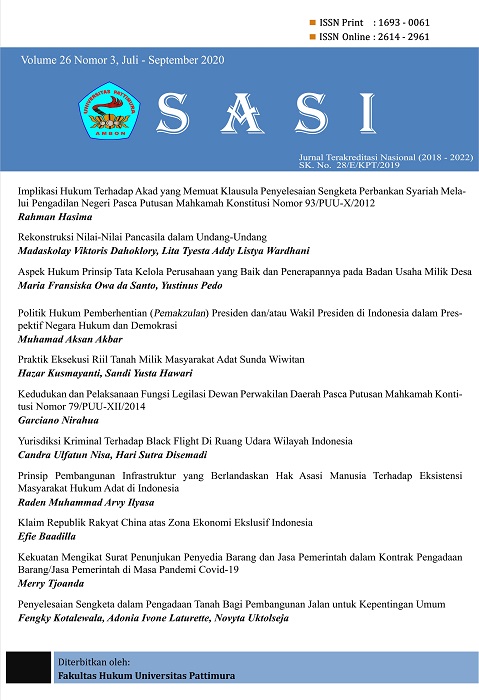
Politik Hukum Pemberhentian (Pemakzulan) Presiden dan/atau Wakil Presiden di Indonesia dalam Prespektif Negara Hukum dan Demokrasi
DOI:
https://doi.org/10.47268/sasi.v26i3.276Keywords:
Politics of law, Termination President and / or Vice President, State Law and DemocracyAbstract
This study aims to determine the legal politics of dismissing the President and / or Vice President in Indonesia. The research method used normative research with a statute approach and a conceptual approach and analyzed descriptive qualitative. The results show that the dismissal of the President and / or Vice President in Indonesia is based on an understanding of a democratic state and an understanding of the rule of law . The application of the concept of a democratic state is carried out through a prior statement of opinion by the DPR and dismissal by the MPR. Meanwhile, the application of the rule of law is carried out through a legal process (forum previlegiatum), namely through examination of trials and decisions in the Constitutional Court. The choice of law is intended to strengthen the presidential system which adheres to the fixed term principle of the position of President and / or Vice President and to ensure the implementation of a stable state government.
References
[1] Miru, I.R. (2017). "Pemberhentian Presiden dan/atau Wakil Presiden dalam Kaitannya dengan Upaya Mewujudkan Negara Hukum Demokratis Indonesia". Mimbar Keadilan Jurnal Ilmu Hukum, 66-79 DOI: https://doi.org/10.30996/mk.v0i0.2200,h. 77
https://doi.org/10.30996/mk.v0i0.2200 DOI: https://doi.org/10.30996/mk.v0i0.2200
[2] Mulyanti, D. (2018). "Mekanisme Pemberhentian Presiden dalam Sistem Pemerintahan Presidensial di Indonesia (Tinjauan Perbandingan Hukum di Negara Amerika Serikat, Filipina dan Sudan)". Jurnal Ilmiah Galuh Justisi, 6 (2).
https://doi.org/10.25157/jigj.v6i2.1714 DOI: https://doi.org/10.25157/jigj.v6i2.1714
[3] Kristiyanto, E. N. (2013). "Pemakzulan Presiden Republik Indonesia Pasca Amandemen UUD 1945". Jurnal RechtsVinding, 2 (3).
https://doi.org/10.15642/ad.2012.2.2.185-207 DOI: https://doi.org/10.33331/rechtsvinding.v2i3.63
[4] Sulistiani, A. (2018). "Impeachment Presiden (Studi Perbandingan Ketatanegaraan Indonesia dan Ketatanegaraan islan)". Jurnal Al-Dastur, 1 (1).
https://doi.org/10.30863/jad.v1i1.348 DOI: https://doi.org/10.30863/jad.v1i1.348
[5] Gunawan, W. A. (2008). "Pemakzulan (Impeachment) Presiden dalam Prespektif Hukum Tata Negara", Jurnal Hukum dan Pembangunan, Tahun ke-38 Nomor 3.
https://doi.org/10.21143/jhp.vol38.no3.178 DOI: https://doi.org/10.21143/jhp.vol38.no3.178
[6] Marzuki, L. (2010). "Pemakzulan Presiden/Wakil Presiden Menurut Undang-Undang Dasar 1945". Jurnal Konstitusi, 7 (1). DOI: https://doi.org/10.31078/jk712
[7] Nadir. (2012). "Dilematika Putusan Mahkamah Konstitusi vs Kekuatan Politik dalam Impeachment Presiden". Jurnal Konstitusi, 9 (2). DOI: https://doi.org/10.31078/jk925
[8] Marzuki, Laica. (2006). Berjalan Jalan di Ranah Hukum. Jakarta: Sekretariat Jenderal Mahkamah Konstitusi dan Kepaniteraan Mahkamah Konstitusi.
[9] Mahfud, M.D. (2011). Perdebatan Hukum Tata Negara. Jakarta: Rajawali Pers.
[10] Mahfud, M.D. (2012). Politik Hukum di Indonesia. Jakarta: RajaGrafindo Persada.
[11] Wahjono, P, (1986). Indonesia Berdasar Atas Hukum, Jakarta: Ghalilia Indonesia.
[12] Nazriyah, R. (2007). MPR RI Kajian terhadap Produk Hukum dan Prospek di Masa Depan. Cetakan Kedua, Yogyakarta: FH UII Press.
[13] Sekretaris Jenderal MPR RI. (2011). Panduan Pemasyarakatan Undang-Undang Dasar Negara Republik Indonesia Tahun 1945 dan Ketetapan Majelis Permusyawaratan Rakyat. Jakarta: Sekretariat Jenderal MPR RI.
[14] Zoelva, H. (2014). Impeachment Presiden Alasan Tindak Pidana Pemberhentian Presiden Menurut UUD 1945. Cetakan Kedua (Edisi Revisi). Jakarta: Konstitusi Press
[15] Asshiddiqie, J. (2005). Mekanisme Impeachment dan Hukum Acara Mahkamah Konstitusi" Kerjasama Mahkamah Konstitusi Republik Indonesia dengan Konrad Adenauer Stiftung, Laporan Penelitian, Jakarta.
Downloads
Published

Article History
Issue
Section
License
Copyright (c) 2020 Muhammad Aksan Akbar

This work is licensed under a Creative Commons Attribution-NonCommercial 4.0 International License.
How to Cite
Article Metrics