
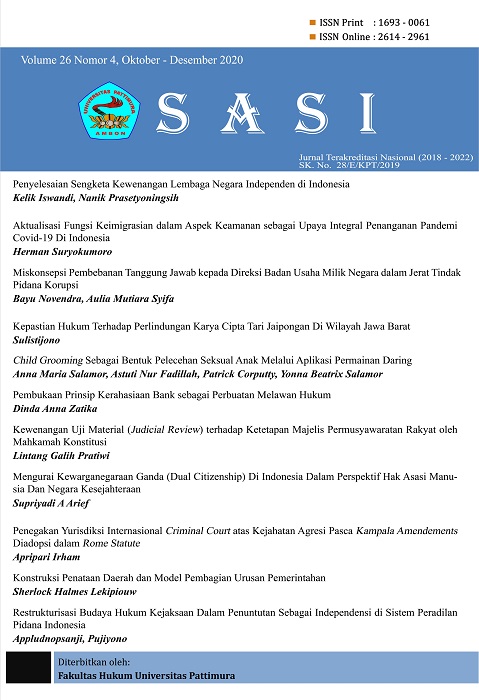
Child Grooming Sebagai Bentuk Pelecehan Seksual Anak Melalui Aplikasi Permainan Daring
DOI:
https://doi.org/10.47268/sasi.v26i4.381Keywords:
Chlid, Sexual abuse, Online.Abstract
The rapid development of society and the development of technological advancements with the use of the internet in addition to having a positive impact can also have an impact with increasing crime that appears With a variety of modus operandi based on technological tools that if not accompanied by the development of knowledge in society about the law will cause a person to become a criminal or being a victim of a criminal offense is not uncommon for children to be targeted as victims. One form of crime that occurs in society is the crime of sexual abuse of children through the internet so that the development of the rule of law is also demanded to be able to overcome the development of this problem. This study aims to assess and analyze whether child grooming can qualify as a form of sexual abuse against children. The method used in this study is normative juridical. The results obtained show that child grooming in Hago games through online media is done with the victim mode being asked to send photos or videos without using clothes or naked by the groomer. Groomer builds closeness with the initial mode of asking for the victim's wa number and establishing closeness, giving rise to sympathy and empathy so that closeness is established between the victim and the perpetrator.References
Jurnal
[1] Gill, A. K., Harrison, K. (2015). Child Grooming and Sexual Exploitation: Are South Asia Men the UK Media'S New Folk Devils. International Journal for Crime, Justice and Social Democracy, 4 (2): 34-49. https://doi.org/10.5204/ijcjsd.v4i2.214
[2] Hilmi, M. F. (2019). Kekerasan Seksual Dalam Hukum Internasional. Jurist-Diction, 2 (6): 2199-2218. https://doi.org/10.20473/jd.v2i6.15949
[3] Kurnianingsih, S. (2011). Pelecehan Seksual Terhadap Perempuan di Tempat Kerja. Buletin Psikologi, 11 (2): 116-129.
[4] Oktaviani, D. L., Mulyawati, K. R. (2020). Kebijakan Hukum Terhadap Tindak Pidana Child Grooming. Kertha Wicaksana, 14 (2): 118-123, https://doi.org/10.22225/kw.14.2.1919.118-123
[5] Purwanti, A., Zalianti, Marzelina. (2018). Strategi Penyelesaian Tindak Kekerasan Seksual Terhadap Perempuan dan Anak Melalui RUU Kekerasan Seksual. Masalah-Masalah Hukum, 47 (2): 138-148. https://doi.org/10.14710/mmh.47.2.2018.138-148
[6] Purandari, T. (2019). Pertanggungjawaban Hukum Pelaku Eksploitasi Seksual Pada Anak Melalui Internet. Media Juris, 2 (2): 233-258, DOI: 10.20473/mi.v2i2.12717. https://doi.org/10.20473/mi.v2i2.12717
[7] Rofida, Z., Boroya, N., Wati, D. M. (2017), Hubungan antara Kekerasan Seksual dengan Fungsi Seksual Perempuan di Kabupaten Jember, Jurnal Pustaka Kesehatan, 5 (2): 193-198.
[8] Syarif, N. (2012), Kekerasan Fisik dan Seksual (Analisis Terhadap Pasal 5 A dan C UU No. 23 Tahun 2004 Ditinjauh Dari Perspektif Hukum Islam). Al-'ADALAH, 10 (4): 423-434.
[9] Sumera, M. (2013). Perbuatan Kekerasan/Pelecehan Seksual Terhadap Perempuan. Jurnal Lex et Societatis, 1 (2): 39-49.
Buku
[10] Ahsini. (2014). Mencegah Dan Menangani Kekerasan Seksual Terhdap Perempuan Dan Anak. Jakarta: Buku Saku
[11] Arifah. (2013). Perlindungan Hukum Terhadap Anak Sebagai Korban Pelecehan Seksual.Yogyakarta: Fakultas Syariah dan Hukum Universitas Islam Negeri Sunan Kalijaga.
[12] Gultom, Maidin. (2010). Perlindungan Hukum Terhadap Anak Dalam Sistem Peradilan Pidana Anak di Indonesia. Bandung: Refika Aditama.
[13] Sitompul, Arsil. (2001). Hukum Internet. Bandung: Citra Aditya Bakti
[14] Soekanto, S, & Mamudji, S. (2001). Penelitian Hukum Normatif (Suatu Tinjauan Singkat). Jakarta: Rajawali
[15] Wahid, A, & Irfan, M. (2000). Perlindungan Terhadap Korban Kekerasan Seksual. Bandung: Refika Aditama.
Online/World Wide Web
[16] Gadis.co.id Tipe pelecehan seksual <https://www.gadis.co.id/Ngobrol/3-tipe-pelecehan-seksual-yang-perlu-kamu-ketahui-?p=4>.
[17] Tirto.id Modus pelecehan seksual disekolah < https://tirto.id/modus-modus-pelecehan-seksual-di-sekolah-clpX>.
Published

Article History
Issue
Section
License
Copyright (c) 2020 Anna Maria Salamor, Astuti Nur Fadillah Mahmud, Patrick Corputty, Yonna Beatrix Salamor

This work is licensed under a Creative Commons Attribution-NonCommercial 4.0 International License.
How to Cite
Article Metrics